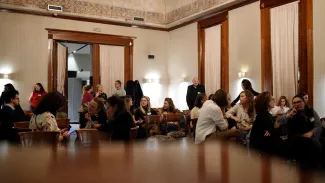
My notes from the EuPRA conference stayed locked inside my new notebook for a bit longer than I expected. When I finally reopened it, Sarajevo came back through lines of notes, quotes, and scraps of thoughts: with steam rising from small copper cups, with the smell of zeljanica lingering out onto the streets, with Baščaršija waiting for the sun to come behind the fog, and with East and West sitting at the same table over bosanska kafa.
Sarajevo is a place that is holding onto warmth and openness, even as it carries the weight of the siege visibly written into its being, like a still-healing wound. In this setting and surrounded by both examples of everyday peace actions and memories of a violent past, the EuPRA Conference 2026 highlighted the importance of practising peace, never leaving it as just an abstract subject to study.
Here are a few reflections based on what has been discussed over three meaningful days:
The conference began with a warm and heartfelt welcome, before moving straight into asking us to confront how the growing professionalisation of our field has started to become a refuge from real accountability. In the first keynote speech, it was noted that those who hold the most privilege within the field are sometimes the least willing to push for meaningful change – a sobering reminder that peace research itself is not immune to the power dynamics it critiques. Moreover, occasionally we are all susceptible to becoming like Nick from Connecticut (the character in Selma Asotić’s poem They Descend Upon Us that was shared that morning): well-intentioned, but at risk of turning other people’s experiences into academic jargon and stepping stones toward career advancements. It was an uncomfortable start, but a necessary one, leaving us with a question that echoed across all three days: how should one do peace research?
Many of the answers pointed towards doing our work collaboratively whenever possible, co-creating knowledge with the communities at the heart of our studies. Those directly experiencing violence, or living in regions affected by it, need far more say in how peace is defined, researched, and acted upon. This is not to say that one can only do peace research if they come from a specific place or community. Rather, when working as an outsider to a context, it is important to reflect critically on your practice and do your best to ensure the work is neither extractive nor overly prescriptive. As an insider, the task is to examine your own biases and unconscious assumptions. Most of the time, we find ourselves alternating between the two, and it is equally important to acknowledge this fluidity, along with the distinct opportunities and challenges that come with occupying these positions.
Furthermore, as researchers, when we are genuine and open to sharing our stories, people (either prospective research participants or audiences to our work) are far more likely to engage with us and our research. A moment of vulnerability is created then, fragile yet deeply impactful in shaping the bridge between academia and the wider public.
Another shared thread across the sessions I attended was the importance of peacebuilding education. Young people inherit stories, attitudes, and ways of seeing the Other, yet they are far from passive recipients. As the leaderless student movement in Serbia demonstrated, young people are already challenging entrenched narratives and driving change on their own terms. Still, youth – and, if I may add, all of us – need real opportunities to practise peacebuilding in daily life, rather than treating it as an abstract ideal. While short online programmes help widen access, they rarely offer the depth needed to cultivate meaningful dialogue and genuine possibilities for collaboration. Thus, peace education cannot be rushed; it demands time and sustained commitment.
From Bosnia and Herzegovina to Congo, from India to Sudan, and from Ukraine to the Middle East, we heard of people pushing for recognition, accountability, and reparations. Out of these timely presentations also came a call to change how we imagine places and the people affected by violent conflict. These communities are too often described as endlessly restless, sometimes ignoring how people there create, rebuild, resist violence and push for positive change. Furthermore, some speakers, such as Micheline Mwendike, also reminded us to enjoy life, to take care of ourselves, and to open more space for others to come in and join. There was indeed a much-needed and much-welcomed emphasis in the conference on the importance of coming together, sharing, hoping, and building bridges, as these seemingly simple acts are much necessary actions for building a better future.
On the last day, I tried to put some of that into practice by leading a workshop on emotional labour, where participants explored self-care, mutual support, and grounded hope. We tried out some Theatre of the Oppressed techniques to reflect on our personal and professional struggles and imagine more just, sustainable ways of doing research. I am genuinely thankful to everyone who came along, for their openness, their willingness to engage, and for their patience with a facilitator who has been a bit out of practice.
The conference gave me space to learn, ask questions, and connect with peers across disciplines, backgrounds, and borders. I left it feeling inspired, less alone in the work, and better prepared to start a new chapter as a recent PhD graduate.
I would also like to take a moment to say how grateful I am to those who gently pushed me to stand for the EuPRA board, and to everyone who voted for me. Stepping forward wasn't something I planned on, which makes the support even more special. Now elected, I will do my very best to contribute as meaningfully as possible to EuPRA’s work over the next two years.
So, to everyone I met at EuPRA 2026, thank you and I hope our paths will cross again sometime soon.