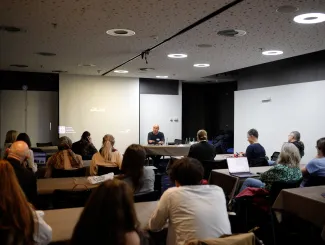
Among the many panels organised at the European Peace Research Association's conference in Sarajevo in November 2026, one focused on doing feminist peace research. Session 14, Feminist Peace Research, chaired by Sina Jasmin Krämer (Tampere University), unsettled many of the assumptions on which our knowledge of peace currently rests. Across four presentations, one question returned again and again: whom and what do we recognise as peace, and through which frameworks do we come to know it?
As a participant in the panel, I left with the sense that this was ultimately the question we were all trying to grapple with. Even though our contributions were very different, varied in their methodologies and epistemological orientation, each of us turned our analytical lens back onto the categories that may often be considered as "settled": the peace actor, the "moment" of peace, the environment in which peace norms travel, and the position of researchers and their collaborators themselves. This post reflects on these contributions, and on what they suggest about where research on peace is heading.
The first presentation, 'The Triangle of Trust: Relational Dynamics in Interpreter-Assisted Interviews on Sensitive Topics', which I delivered with my co-author Ana Gvozdić (Uppsala University), brought these questions to bear on the conduct of fieldwork. It examined the role of interpreters in cross-language interviews on sensitive topics in conflict-affected societies. Much of the methodological literature treats trust instrumentally, as a criterion for hiring an interpreter who will safeguard the integrity of the data and, in doing so, it casts the interpreter as a neutral conduit and overlooks the trust that interviewees and interpreters must in turn place in the researcher. Drawing on field notes and diaries kept throughout fieldwork in Bosnia and Herzegovina, we proposed instead a 'triangle of trust', capturing the relational and ever-evolving dynamics between researcher, interpreter and interviewee before, during and after the interview. Engaging feminist research ethics and an ethics of care, we argued that interpreters are active participants in the production of knowledge, whose presence shapes what can be said, heard and shared.
In the second presentation, 'Reclaiming Everyday Peace: Women's NGOs and Feminist Peace Work during the 2001 Conflict in North Macedonia', Daniela Antonovska (President of EKVALITIKO, North Macedonia) took up a question of recognition, seeking to reclaim the everyday peace work of women's organisations. Peace processes, she argued, tend to recognise elites, armed actors and international mediators as the protagonists of a settlement. Women's organisations, which supported women and families through the conflict with scarce resources and limited infrastructure, remained largely invisible in the agreement itself. Antonovska named this an 'exclusion gap': women were absent from the formal settlement despite having contributed much of the labour that made it possible. This raises a question for the field. If grassroots actors are lost when their work is translated into formal and bureaucratic processes, must we rethink those processes, and not only who is invited into them?
In the third presentation, 'Undocumented Bodies and Territories of War: Feminist Perspectives on the Continuum between Violence and Peace', Anna Micol Tropeano and Daniela Susarenco (Sapienza University of Rome) proposed a theoretical framework that starts from the body: if violence is an embodied experience, how might we rethink peace as an everyday bodily practice? While the physicality of violence is intuitive, what it would mean to feel peace in the body is far less so, and a working definition of peace as bodily experience remains an open task. The framework was developed through two cases, Colombia and Italy, where violence unfolds in very different ways. Tracing a continuum of violence, the presentation followed how bodies are made and remade across conflict and its aftermath.
Finally, in the fourth presentation, 'Bosnia and Herzegovina as a Normative Laboratory: The Case of Children Born of Wartime Rape', Lucie Fayoux (Sciences Po Lille) turned to children born of wartime rape in Bosnia and Herzegovina, often described as the forgotten victims of war. She examined the recent legislative breakthrough that allows these children to obtain official status and asked why such a law emerged some thirty years after the war ended. Rather than reading this as norms descending from the international level to local actors, Fayoux proposed a 'sandwich' model, in which pressures from above meet pressures from below to produce legislative change. The presentation then asked what this means for other contexts in which the same violence is being committed, tracing possible diffusion from Bosnia and Herzegovina to Ukraine. More broadly, it called for rethinking the geography of transitional justice, challenging the assumption that such norms originate in Western states while other centres of norm production go unconsidered.
Read together, the four presentations unsettled a familiar picture of peace and of how we come to know it. Knowledge about peace, they suggested, is not produced by researchers standing outside the field, but co-produced with interpreters and participants whose labour often goes unrecognised. Nor is peace made only by those visible at the negotiating table, or does it begin at the moment an agreement is signed: it is built through the uncounted work of grassroots actors, and lived, felt and contested in the body long after any formal settlement and in seemingly “peaceful” societies. The norms that shape its aftermath, in turn, do not simply travel outwards from Western centres, but take form where pressures from above meet pressures from below, in places the field has rarely considered.
Hence, perhaps the most productive direction for the field lies in holding these challenges together, recognising whose knowledge and labour count, attending to how peace and violence are lived, and remaining answerable for our own frameworks are not separate agendas.