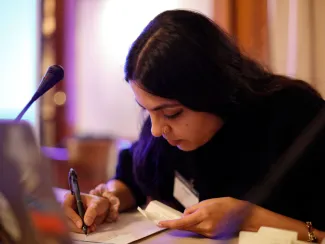
I want to start this blog by mentioning that the conference was inclusive and different from the other academic conferences. From the location of the conference in Sarajevo, Bosnia to its activist-academic focus, the conference provided a safe space for people to share their views. I am writing this particularly as an early career researcher, that this is the first time that I have ended a conference with hope. This is not to romanticize the concept of hope, but in this context, I refer to hope as having been critical of the 'military-academic' nexus. It was truly wonderful to listen to the keynote by Slađana Lazić on addressing the state of academia and peace researchers and the poem about Nick from Connecticut. This only happens so often that academia moves beyond formal conversations to actually addressing the extractivists nature of the research. This is important for researchers to reflect on their own positionality and nature of research. This is decoloniality in practice. I said wonderful earlier because it doesn't happen so often that this critique of academic military complex will come from the people at the top. It is sadly mostly bottoms up than top down as people with a comfortable position researching on peace would be the last to comment on academic military industrial complex and also on the ongoing genocides.
The keynote made me reflect on my own past experiences as a non-EU Masters student in International Relations in Ireland. I used to wonder why the countries that are referred to as "Global South" were seen as case studies. We are not the ultimate hotspot for peace and conflict studies, but humans and research should see us as just humans and not as mere case studies for data and career advancements.
I am a Doctoral Researcher at Tampere University, and my research focuses on indigenous youth climate activism in India. I presented my experience and approach during my initial ethnographic fieldwork at the session titled "Climate, Ecology, and Peace". I am analyzing how power hierarchies rooted in colonialism, capitalism, and imperialism, and other factors like indigeneity, caste, shape indigenous activists' experience. I am using settler-capitalist framework for my research as in post-independence India, the power got transferred from British to the upper caste upper class elites in India. I got to listen to extremely relevant presentations on neo imperialism, extractivism of resources in this planetary crisis. Other sessions on decolonial and critical peace and youth and peace pedagogies were also extremely relevant and thought provoking for me.
I am thankful for this opportunity to be a part of this conference in Bosnia. Returning home with beautiful memories and wonderful connections. Ending this blog thinking about Bosanska Kahva and Ćevapi.