What does it mean to rebuild peace after conflict? Can societies remember difficult pasts while creating possibilities for a different future? And what role might art, education, and everyday practices play in this process?
These questions accompanied me throughout the European Peace Research Association (EuPRA) Conference, held in Sarajevo, Bosnia and Herzegovina, from 4 to 6 November 2026. Under the theme “Reclaiming Peace and Cultivating Hope Beyond the Crisis Narrative: Towards Accountability and Action,” the conference brought together researchers, educators, activists, and peace practitioners to exchange ideas about contemporary challenges to peace and possibilities for transformation.
Over three days, the programme featured keynote discussions, thematic panels, research presentations, and participatory workshops addressing decolonial and feminist approaches, grassroots peacebuilding, collective memory, education, and the role of art and communication in peace practices.
For me, the conference offered an opportunity to reflect on how peace is connected to the ways societies understand their histories, engage with differences, and imagine their futures.
A Bridge Rebuilt, Piece by Piece
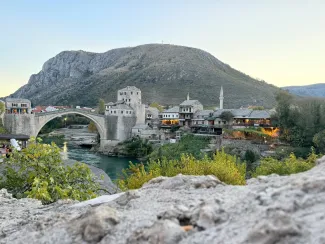
During my time in Sarajevo, a friend shared with me the story of the Old Bridge in Mostar, known as Stari Most. The story particularly resonated with me and stayed in my thoughts as I reflected on the meaning of rebuilding peace after conflict.
Originally built in the sixteenth century, the bridge was destroyed during the war in 1993 and later reconstructed using traditional techniques and materials to restore its historical form, stone by stone.
More than a historic monument, the bridge had connected people, places, and everyday lives. Its reconstruction became a symbol of the possibility of reconnecting what conflict had separated, even though rebuilding the structure could not erase the violence or resolve the divisions left by war.
The story made me reflect on peacebuilding itself. Perhaps peace, like a bridge, cannot simply be restored through a single decision. It requires patience, collective effort, and a willingness to rebuild relationships piece by piece.
Yet rebuilding trust is far more complex than reconstructing a physical structure. It requires acknowledging historical injustices, questioning inherited divisions, and creating new ways of living together.
This raised a question that stayed with me throughout the conference: How can remembering the past become part of rebuilding the future?
Memory, Art, and New Perspectives
On the first day of the conference, I had the pleasure of presenting alongside my colleague Dilara Özel in our panel, “Remembering Peace Otherwise: Memory, Repair, and Lived Practices of Peace.”
My contribution focused on collective memory and the possibilities of art-based peace education in societies affected by conflict, particularly in the context of Azerbaijan.
The stories we inherit, the histories we learn, and the commemorations we encounter influence how we understand ourselves and others. I find it helpful to imagine memory as an invisible backpack containing family stories, photographs, school lessons, and narratives passed from one generation to another.
In societies affected by prolonged conflict, inherited experiences of violence, displacement, loss, and injustice can become closely connected to collective identity and shape how communities perceive one another.
An important question for peace education is how younger generations can acknowledge these histories while remaining open to different perspectives.
This is where I see potential in artistic and creative practices. Art can offer opportunities to explore memories and perspectives beyond conventional discussion.
Imagine asking two children to photograph the same playground. One photographs a broken swing, while the other captures children laughing and playing together. Both photographs represent something real, yet they tell different stories about the same place.
This illustrates how collective memory, like photography, can emphasize certain experiences while leaving others outside the frame. It does not mean that historical facts are simply a matter of perspective. Rather, it encourages us to ask what may be missing from familiar narratives and whose experiences have been overlooked.
Art-based peace education is therefore not simply about producing images of peace. It is about exploring whether creative participation can encourage reflection, dialogue, and new ways of relating to others.
At the same time, art does not automatically create empathy or reconciliation, nor can it resolve historical injustices or political disputes. Its potential contribution must be understood within the wider social and political conditions in which it takes place.
For me, the question is not whether art can solve conflict, but what opportunities creative practices might create for engaging with difficult histories and imagining relationships differently.
Whose Stories Are We Telling?
Another valuable aspect of the conference was engaging with discussions about participatory communication and creative approaches to peacebuilding.
These conversations encouraged me to consider not only how peace is represented, but also who participates in shaping those representations.
A peace campaign may use powerful photographs and hopeful language, but what happens if the communities whose experiences it represents have little influence over the stories being told?
Who decides which perspectives are included, and whose voices remain unheard?
These questions are particularly relevant to participatory artistic practices, which can offer people opportunities to represent their own experiences rather than having them interpreted entirely by others.
Yet participation must be meaningful. Inviting people to contribute does not automatically address inequalities in representation or decision-making.
Peace communication is not only about what we say. It is also about whose voices are heard and who has the opportunity to shape the conversation.
Remembering Without Repeating
One of the questions emerging from these discussions was how societies can engage with difficult histories without allowing inherited divisions to define future relationships.
Historical narratives can preserve important experiences of suffering while also reinforcing boundaries between communities. Engaging critically with them does not mean asking people to abandon their histories. It means considering how those histories are represented, whose experiences are recognized, and whether different futures can be imagined.
This is where memory work, cultural heritage, and art-based peace education intersect. Each can provide opportunities to reflect on what societies inherit and what they choose to carry forward.
Such practices cannot substitute for justice, accountability, or political transformation, but they may contribute to wider conversations about coexistence and repair.
What I Took Away from Sarajevo
Looking back at EuPRA 2026, I was particularly struck by the connections between collective memory, cultural heritage, education, artistic practices, and participatory peacebuilding.
The conference reminded me that peacebuilding involves more than resolving political disagreements or communicating positive messages. It also raises questions of representation, recognition, participation, and the relationships through which communities shape their futures.
For peace education, change may not always be immediate or easily measurable. Sometimes encountering an unfamiliar perspective, questioning an inherited narrative, or participating in a shared creative process may be a meaningful starting point.
These moments should not be mistaken for reconciliation itself, but they may create possibilities for reflection and engagement that deserve further exploration.
I return to the image of Mostar's bridge being rebuilt stone by stone. Its reconstruction offers a reminder that repair requires both an acknowledgment of what has been lost and a commitment to what might still be created.
Perhaps peacebuilding is also a process of learning how to remember without allowing the past to determine every possibility for the future.
And perhaps this work begins piece by piece: through dialogue, education, creative expression, and the willingness to imagine relationships differently.