What kind of order are we reconstructing?
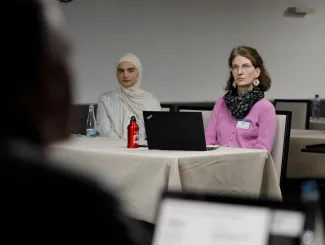
That was the question I ended my presentation with at EuPRA 2026 in Sarajevo, during a session on Decolonial and Critical Peace Studies.
For me, attending the conference was more than an opportunity to present ongoing research. It was also an opportunity to step into an academic space that I approach from a somewhat different disciplinary background. My own work begins in economics, with questions about value, measurement, and the forms through which economic reality becomes intelligible. Over time, those questions have increasingly led me toward questions of crisis, reconstruction, and peace.
Presenting this work in a peace research setting was therefore both exciting and slightly unfamiliar. Throughout the conference, I became increasingly aware of how differently similar questions can be approached depending on the intellectual traditions we come from. The sessions and conversations made me reflect not only on the content of my own project, but also on the way I formulate questions, construct arguments, and understand the relationship between knowledge and the world it seeks to describe.
One of the things I valued most about the conference was precisely this encounter with different ways of thinking. Interdisciplinary spaces do not always produce immediate agreement or easy translation between perspectives. Sometimes they do the opposite. They make our assumptions more visible.
Being surrounded by researchers working from different theoretical, methodological, and disciplinary starting points made me more conscious of the questions I instinctively ask, and of the intellectual habits I bring with me from economics. It also reminded me that entering another field is not simply a matter of applying one discipline to another. It requires learning how different fields frame problems, what they treat as relevant, and what kinds of knowledge they consider important.
That, to me, is part of what makes conferences like EuPRA valuable. They create a space where ideas can move outside the environments in which they were originally developed. In doing so, those ideas can become clearer, but they can also become less comfortable. They are placed beside perspectives they were not originally built to encounter, and that can reveal both their strengths and their limitations.
There was also a deeply personal dimension to being in Sarajevo.
My family fled Bosnia and Herzegovina because of war and genocide. Returning to the, this time to participate in a conference devoted to peace research, was difficult to separate from that history.
To stand in Sarajevo and present work that has gradually moved from economics toward questions of peace felt, in many ways, like a full-circle moment.
That personal dimension did not make the academic experience less important. If anything, it made the questions feel more concrete. Peace, reconstruction, recovery, and the institutions through which societies are rebuilt after violence are not abstract concepts. They are lived realities, shaped by political decisions, economic structures, historical memory, and competing understandings of what a peaceful future should look like.
The conference reinforced for me that peace is not a settled concept, nor is reconstruction a neutral process. Questions about what is rebuilt after violence, what counts as recovery, which forms of knowledge become authoritative, and which relations remain in place after reconstruction do not have simple answers.
They require conversations across disciplines, experiences, and perspectives.
I left EuPRA with my project still unfinished, but with its questions sharpened.
Perhaps that is one of the most valuable things a conference can offer. Not closure, but a space in which an idea can be shared, tested, challenged, placed beside unfamiliar.