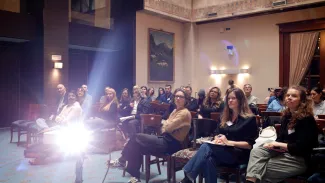
Peace is often seen as an academic concept, but for many people, including myself, it is something deeply personal. Attending the European Peace Research Association (EuPRA) Conference 2026 in Sarajevo, Bosnia and Herzegovina, from 4 to 6 November was therefore more than an opportunity to present my research paper. As an aspiring researcher in the field of peace and conflict studies, it was an especially meaningful experience that connected my academic interests with my family history, my identity and the realities of people who continue to live through conflict today. The theme of the 2026 conference was “Reclaiming Peace and Cultivating Hope Beyond the Crisis Narrative: Towards Accountability and Action”. Researchers, practitioners, artists and activists from different parts of the world came together in Sarajevo. Throughout these three days, all kinds of conversations and discussions touched on topics such as historical injustices, reconciliation, nonviolent resistance and the many ways in which peace can be understood and practised. But, what made this conference meaningful to me personally was not only the research being presented. It was the people behind it and their personal stories. I think Sarajevo was a great choice to hold this conference. As a city that experienced the war in Bosnia and Herzegovina during the 1990s and, still to this day, carries trauma and those consequences, Sarajevo carries a history that continues to shape discussions about peace, memory and reconciliation. For me, this history is also part of my own family's story. Both of my parents are originally from Srebrenica, a town whose name is inseparable from the genocide committed there in July 1995. Growing up with this family connection has meant that questions surrounding war, displacement, historical memory and justice have never felt distant to me. This made attending a peace research conference in Sarajevo a very personal experience.
As I listened to discussions about post-conflict societies, collective trauma and reconciliation, I found myself recognising themes that have always felt familiar. Concepts that are often approached through academic theories and frameworks were closely connected to histories I had grown up knowing. It is interesting, as there was something both comforting and confronting about this familiarity. Comforting, because I was surrounded by people who shared an interest in understanding these complex issues. Confronting, because the subjects being discussed represented experiences that have affected real families and communities, including my own. As someone hoping to pursue a future in peace and conflict research, attending the EuPRA conference reminded me why I am drawn to the field in the first place. Behind every academic discussion about conflict, there are real people whose lives have been shaped and affected by it. One of the experiences that left the strongest impression on me was the presence of participants from countries currently affected by war and violence, including participants from Sudan, Ukraine and from the Democratic Republic of the Congo. Listening to perspectives connected to these contexts made the conference feel especially relevant and confronting. While some participants were examining conflicts through historical research or works of art, others brought perspectives rooted in situations where violence and insecurity remain an everyday reality. This contrast stayed with me. Coming from a family with roots in Srebrenica, I am aware of how the consequences of war can continue across generations. Hearing perspectives from people connected to ongoing conflicts reminded me that what is part of my family's history remains a present reality for many others. One moment that particularly moved me was when a participant shared that she had come to Sarajevo to see what her own country might one day become after the war. Hearing her words made me
emotional, as Sarajevo, despite its painful history, represented a sense of hope for someone still experiencing the realities of conflict. Of course, the histories and political circumstances of Bosnia and Herzegovina, Sudan and the Ukraine are different and should not be treated as interchangeable.
Nevertheless, the conference created space to recognise shared questions about justice, dignity, memory, and the possibility of building peace.
Alongside these reflections, I had the opportunity to present my paper, “Keeping Looted Art Objects in Museums,” during the Decolonial and Critical Peace Studies session on 6 November. My research addresses a controversial question: Should museums retain looted artworks to preserve their cultural and educational significance, even when rightful owners or their descendants seek their return? The paper primarily focuses on artworks looted by the Nazis during the Second World War, particularly those taken from Jewish individuals and families. Although this topic may initially appear more closely connected to museum studies, it also raises fundamental questions within peace and conflict research. Who has the right to preserve and interpret history? How do societies acknowledge historical injustices? And what role can cultural institutions play in reconciliation? My paper explores the argument that museums can serve an important educational purpose by preserving and displaying artworks connected to historical violence. These objects can provide tangible connections to the past, allowing visitors to learn about persecution, dispossession, and the experiences of affected communities. At the same time, I recognise the ethical complexities of this position. For descendants of victims, the restitution of stolen objects can represent much more than the recovery of property. It can be an act of reclaiming dignity, identity and control over their own history. This tension between preservation and restitution was central to my research. Presenting this topic in Sarajevo felt especially relevant because it connected with broader discussions about historical memory and the responsibility of institutions to acknowledge the past.My research also made me reflect on the importance of whose voices are included when we discuss heritage and reconciliation. Preserving history should not mean overlooking the perspectives of those whose histories are being represented.
Looking back, EuPRA 2026 was much more than an academic conference for me. It was an opportunity to present my research, encounter different perspectives and reflect on my own connection to the subjects I hope to continue studying. Having parents from Srebrenica made the discussions about historical violence, memory and reconciliation feel especially close to home. At the same time, encountering perspectives from participants connected to ongoing conflicts reminded me that the search for peace remains an urgent and unfinished process. The experience also strengthened my ambition a lot to pursue a future in peace and conflict research. Being able to contribute to these discussions, while learning from people with different academic and personal backgrounds, made me feel part of a wider community committed to understanding conflict and working towards more peaceful societies. The conference's emphasis on cultivating hope beyond crisis narratives felt particularly important. Hope in this case means recognising that even in difficult times, there is space for dialogue, solidarity, accountability and change. For me, EuPRA 2026 reinforced that peace is not merely something we research. It is something we inherit, remember, question and continuously work towards.