What does peace look like beyond political agreements and the absence of violence? How do our memories, emotions, and everyday relationships influence the ways we experience peace? And can creative practices help us imagine different ways of living together?
These were some of the questions I explored at the European Peace Research Association (EuPRA) Conference, held in Sarajevo, Bosnia and Herzegovina. Under the theme “Reclaiming Peace and Cultivating Hope Beyond the Crisis Narrative: Towards Accountability and Action,” the conference brought together researchers, educators, and peace practitioners to reflect on contemporary challenges to peace and possibilities for transformation.
Sarajevo provided a particularly meaningful setting for these conversations. As a city shaped by experiences of conflict, loss, resilience, and coexistence, it reminds us that peace is not simply achieved through political agreements. It is also shaped through everyday relationships, collective memories, and the ways societies engage with difficult pasts.
Throughout the conference, I found myself returning to one central idea: peace is not only something we seek to achieve, but something we experience, negotiate, and practice in everyday life.
Remembering Peace Otherwise: What We Carry, Feel, and Pass On
On the first day of the conference, I had the pleasure of presenting alongside my colleague Dilara Özel in our panel, “Remembering Peace Otherwise: Memory, Repair, and Lived Practices of Peace.”
The panel brought together questions about memory, embodiment, education, and everyday experiences of peace, exploring how the past shapes our sense of safety, belonging, identity, and relationships with others.
One of the central questions I reflected on was what it actually means to experience peace.
Peace is often understood as the absence of direct violence. However, this does not fully explain how people experience safety or insecurity in their everyday lives.
Imagine two people entering the same unfamiliar room. One feels relaxed and comfortable, while the other feels anxious and cautious. Although they are in the same environment, their experiences of safety may be very different.
This simple example illustrates an important distinction: being objectively safe and feeling safe are not always the same.
Our experiences of safety are influenced not only by present circumstances, but also by previous experiences, emotions, relationships, and memories. Sometimes these memories can be communicated through stories. At other times, they may be expressed through bodily responses or feelings that are difficult to put into words.
This understanding of memory also invites reflection on what we inherit from others.
I find it helpful to imagine memory as an invisible backpack that we carry throughout our lives.
Inside this backpack are stories from parents and grandparents, experiences from school, photographs, public commemorations, and narratives encountered through the media.
Some of these memories belong to our own experiences. Others concern events that happened before we were born. Yet they can become equally important in shaping how we understand ourselves, our communities, and other people.
In societies affected by prolonged conflict, inherited memories may include experiences of violence, displacement, loss, and injustice. They can become deeply connected to collective identity and influence how individuals perceive those belonging to other communities.
These connections between embodied experiences and inherited memories raise important questions for peace education.
How can educational spaces allow people to feel safe enough to explore difficult memories? How can children engage critically with inherited narratives without feeling that they must reject their family histories? And how can educational practices encourage openness to different perspectives while remaining sensitive to experiences of suffering?
These questions suggest that peace education is not simply about teaching people to think positively about others. It is also about understanding how memories, emotions, and social relationships influence our capacity to engage with difference.
Art, Memory, and the Possibility of Seeing Differently
One of the possibilities I explored in my presentation was the role of artistic and creative practices in engaging with memory and relationships.
Traditional approaches to peace education often emphasize discussion, dialogue, and reflection. However, difficult memories and emotions are not always easy to communicate through words, particularly in societies where conflict narratives are politically sensitive.
Art can offer alternative ways of expressing experiences, exploring perspectives, and engaging with others.
Consider a simple photography activity.
Imagine asking two children to photograph the same playground. One takes a photograph of a broken swing, while the other captures children laughing and playing together.
Both photographs represent something real, yet they communicate different stories about the same place.
This example helps illustrate how memory works. Like photography, memory is selective. We remember certain details, emphasize particular experiences, and sometimes leave other perspectives outside the frame.
It also raises a broader question: How often do we assume that our own perspective represents the complete picture?
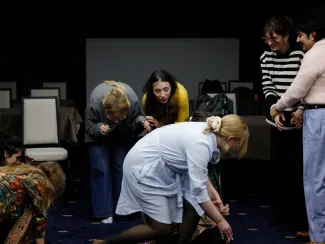
Other creative practices, such as mime, sculpture, zine-making, and collaborative art, can offer different opportunities for exploring emotions, identities, boundaries, and relationships.
In this sense, peace becomes more than an abstract concept. It can be explored through everyday experiences of cooperation, disagreement, negotiation, and shared decision-making.
These creative processes also connect with embodied understandings of peace. Participation involves not only exchanging ideas, but also navigating emotions, recognizing boundaries, responding to others, and experiencing different degrees of comfort or uncertainty.
However, I believe it is important not to romanticize artistic practices. A collaborative painting does not automatically transform conflict narratives, and creative expression does not necessarily produce empathy or reconciliation.
Art cannot replace political accountability, justice, or structural transformation.
Its potential contribution lies in creating opportunities for reflection, expression, and relational learning, while recognizing that these opportunities are shaped by wider social and political conditions.
Peace Beyond Agreement: Reflections from the Conference
The wider conference discussions reinforced many of the questions I explored in the panel.
Across different sessions, participants reflected on the importance of decolonial and feminist perspectives, grassroots peacebuilding, education, artistic practices, and the relationship between peace research and everyday experiences.
These conversations encouraged me to think critically about who defines peace, whose experiences are recognized, and whose voices remain unheard.
They also highlighted the importance of moving beyond approaches that treat peace as a message to be delivered or a predetermined outcome to be achieved.
This became particularly relevant during discussions about participatory communication and creative peace practices.
Peace communication is often imagined as producing campaigns, sharing positive messages, or encouraging dialogue between divided communities.
But communication is not automatically inclusive simply because its message promotes peace.
Imagine a campaign encouraging reconciliation between communities affected by conflict. The campaign may use powerful images and hopeful language, but what happens if the communities themselves have not participated in creating it?
Who decides which stories should be told? Whose experiences are represented? And what happens to perspectives that do not fit the intended message?
These questions remind me that peace communication is not only about what is communicated, but also about how communication takes place and who has the opportunity to participate.
What I Took Away from Sarajevo
Looking back at the conference, I was particularly struck by how conversations about memory, embodiment, education, art, and participation continually intersected.
Although these themes are often explored through different academic disciplines and methodological approaches, they share a concern with how people experience and negotiate peace in everyday life.
Peace is connected to how we remember the past, how our bodies respond to safety and uncertainty, how we communicate with others, and whether we have meaningful opportunities to participate in shaping our relationships and communities.
For peace education, this means moving beyond the expectation that transformation must always be immediate, visible, or measurable.
Sometimes meaningful engagement may begin with a question, an unfamiliar perspective, a moment of reflection, or an opportunity to negotiate disagreement.
At the same time, I believe it is important to remain attentive to the limits of these small-scale practices. Artistic and educational initiatives cannot substitute for political solutions, structural change, or accountability for violence.
Their possible contribution lies in opening spaces where different ways of relating, remembering, and imagining the future can be explored.
One idea stayed with me throughout the conference: remembering differently does not mean forgetting the past.
It means recognizing that memory is not simply a fixed record of what happened. It is also something that shapes how we understand ourselves and others in the present.
And while we cannot change the past, we can continue to question whether inherited memories must determine every relationship we create in the future.
I am grateful for the opportunity to present alongside my colleague Dilara Özel and to engage with researchers and practitioners from different contexts at EuPRA 2026.
The conference strengthened my interest in exploring the possibilities and limitations of art-based peace education, particularly in societies where memories of conflict continue to shape everyday relationships.
Perhaps peace does not begin when everyone remembers the past in the same way, but when people become capable of recognizing different memories without allowing them to become reasons for continued hostility.
And sometimes, imagining peace differently can begin with something as simple as a photograph, a shared story, a collaborative artwork, or the willingness to listen.