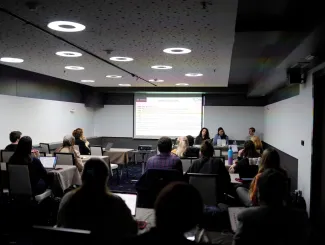
From 4 to 6 November 2026 I attended the European Peace Research Association (EuPRA) Conference in Sarajevo. It's hard to talk about war and memory in a city that lived through a siege and that gave many of the discussions extra weight. The city itself felt like part of the program, constantly grounding the theoretical debates in lived experience.
Throughout the conference, several panels offered profound insights, but three presentations stayed with me and left a lasting impression on my understanding of peace research.
Session 1: Decolonial and Critical Peace Studies The presentation "Agency Under Siege: Writing Back as a Tool of Resistance" looked at writing during war. It isn't only a way to survive. It's also a way to keep a record and hold on to some control when everything else is taken away. The speaker compared two books/diaries. In Selidbe, written during the siege of Sarajevo, Dževad Karahasan reflects on how people kept their dignity through small daily routines while their world fell apart. The second was I Am Transforming… Diary of Occupation by Ukrainian writer Volodymyr Vakulenko. In 2022 he buried his 36-page handwritten diary under a cherry tree in his garden, shortly before he was killed. The diary was later dug up and published. I kept thinking about that image long after the session ended. It showed me how a single act of writing can outlast the violence meant to silence it.
Session 4: Feminist Peace Research "Into Which Narrative Was I Born? Inherited Histories and the Possibility of Peace" asked how each side of a conflict shapes history to fit its own needs. In post-war Bosnia and Herzegovina, children from different ethnic groups often learn completely different versions of the same historical events. The presenter asked whether a single objective truth can exist when history is used this way, and how researchers can deal with their own subtle biases when they study it. I don't think there's an easy answer to these dilemmas, but it's a fundamental question every researcher in this field should keep asking.
Session 14: Feminist Peace Research "BiH as a Normative Laboratory: The Case of Children Born of Wartime Rape" focused on a group that is still mostly overlooked. The presenter explained the legal and administrative barriers that keep these children from being recognized as a distinct group with specific rights. She also talked about how carefully she approached her interviews, building trust and protecting the dignity of the people she spoke with. Crucially, the study used Bosnia and Herzegovina as a "normative laboratory," tracing how legal norms, advocacy frameworks, and rights-based recognition developed in BiH now serve as key references for similar human rights challenges coming out of the war in Ukraine today.
The 2026 EuPRA Conference in Sarajevo was a powerful reminder that peace research is not merely an academic exercise. It is about honoring lived experiences, protecting fragile memories, and dismantling biased frameworks to advocate for marginalized voices. Leaving Sarajevo, I feel reaffirmed in the importance of centering human dignity and ethical responsibility in all ongoing work for peace and justice.